

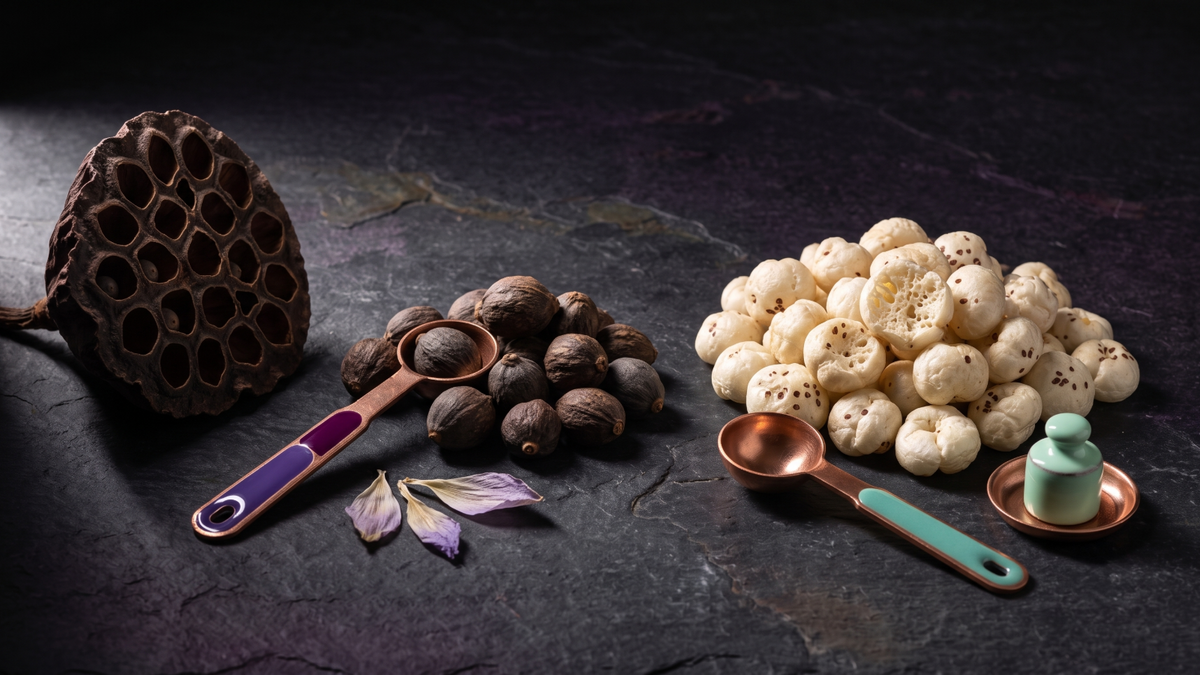
If you have never met a makhana, you have been missing one of the most quietly impressive foods on earth. You might know it as a fox nut, a lotus seed or a popped water-lily seed. In India it is simply makhana, and it has been eaten for centuries.
This guide covers what makhana actually is, where it comes from, how it is made, what published research says about its nutrition, and the practical bit — how to eat it.
What is makhana, exactly?
Makhana is the popped seed of Euryale ferox, a water lily that grows in shallow freshwater ponds. Despite the name "fox nut", it is not a nut at all — it is a seed. That matters if you are shopping with a tree-nut allergy in mind, though you should always check the pack, because facilities vary.
Raw seeds are hard and unappetising. Heat changes everything: applied correctly, the starch inside expands and bursts through the black shell, producing a white, airy pearl. It is closer to popcorn in physics than to any nut.
Fox nut, lotus seed or water-lily seed?
All three names circulate, and they cause genuine confusion:
- Makhana / fox nut — the popped seed of Euryale ferox. This is what we sell.
- Lotus seed — often used loosely for makhana, but also refers to seeds of Nelumbo nucifera, a different plant used in East Asian cooking.
- Water-lily seed — botanically the most accurate everyday description.
Where makhana comes from
The overwhelming majority of the world's makhana comes from Bihar in north-east India, particularly the Mithila region around Darbhanga and Madhubani. It is grown in ponds and wetlands, and harvesting is genuinely difficult work: seeds are gathered by hand from the pond bed, often by divers, over repeated passes.
That labour intensity is why makhana has never been a cheap commodity crop, and why the supply chain matters. Ours is hand-harvested in Bihar and then roasted and seasoned for the UK — you can read the full journey on our Our Journey page.
How makhana is made, step by step
- Harvest. Seeds are collected by hand from the pond bed.
- Washing and grading. Seeds are cleaned and sorted by size — size determines the quality grade.
- Sun-drying. Seeds are dried to bring moisture down to the right level for popping.
- Tempering and popping. Seeds are heated, then struck so the kernel bursts out of its shell as a white pearl.
- Roasting and seasoning. The popped pearls are roasted — never deep-fried — and seasoned.
That "roasted, not fried" distinction is the whole point. Frying is what turns a light seed into a heavy snack. For a fuller walkthrough with video, see What is a Makhana.
Makhana nutrition: what the research actually shows
Makhana is naturally low in fat, contains plant protein and dietary fibre, and supplies minerals including magnesium, calcium, potassium and phosphorus.
The more interesting findings concern what happens when you roast it. In a study published in Food Production, Processing and Nutrition, roasted fox nuts were found to contain higher concentrations of phenolics, flavonoids, minerals and antioxidants than raw seeds, and were measured as having a low glycaemic index in human subjects [1].
A separate 2023 analysis in the Journal of Food Measurement and Characterization compared raw and popped makhana directly and found roasting raised total phenolics from roughly 346 to 471 mg GAE/100g, increased flavonoid content, and improved DPPH radical-scavenging activity from about 49% to 79% inhibition [2]. The same work identified catechin and gallic acid among the main free phenolic compounds.
In plain English: popping and roasting makhana does not strip its useful compounds — on these measures it concentrates them.
A note on honesty
Published glycaemic index figures for makhana vary depending on the sample and the method used. We would rather point you to the research and let you read it than quote a single number as though it settles the matter. Full verified nutritional values for each of our flavours are printed on every product page.
What does makhana taste like?
On its own, mild — subtly nutty, faintly savoury, with a texture somewhere between popcorn and a puffed rice cake. It is unusually light: you can eat a handful without the heaviness that follows fried crisps.
That neutrality is exactly why it works as a seasoning carrier. It takes flavour without fighting it:
- Himalayan Pink Salt & Black Pepper — the purist's version. Four ingredients, zero sugar.
- Dark Cacao — dark chocolate with crushed almonds, for an evening craving.
- Peri-Peri & Lime — smoky chilli warmth with a citrus finish.
How to eat makhana
- Straight from the pack — the intended use, and the best one.
- Over yoghurt or porridge — adds crunch without sogginess.
- On salads and grain bowls — a lighter substitute for croutons.
- On a snacking board — it holds its own next to cheese and dips.
- In a lunchbox or gym bag — it does not crush, melt or leak oil.
Common questions
Is makhana a nut?
No. It is a seed from a water lily. It is not botanically a tree nut, though it is often made in facilities that also handle nuts — always check the allergen information on the pack.
Is makhana gluten-free and vegan?
The seed itself is naturally both. Whether a finished product is depends on the seasoning, so read the label. All three Pop Pearls flavours are vegan-friendly and made without gluten-containing ingredients.
Is makhana better than popcorn?
They are more similar than most people expect, and different in ways that matter. We compared them properly here: Makhana vs popcorn — the honest comparison.
How much makhana should I eat?
Treat it as a snack, not a meal. A 25–50g portion is a sensible serving, as part of a varied and balanced diet.
Where to start
If you are new to makhana, start with pink salt and pepper — it shows you what the seed itself tastes like. If you would rather try everything, the Trio Bundle has one pouch of each, or browse the full range in our shop.
Curious about the nutrient most of us fall short on? Read why fibre is the snack nutrient you are probably missing.
References
- Roasted fox nuts (Euryale ferox L.) contain higher concentration of phenolics, flavonoids, minerals and antioxidants, and exhibit lower Glycemic Index (GI) in human subjects. Food Production, Processing and Nutrition. link.springer.com
- Differentiating the nutrient composition, in-vitro starch digestibility, individual polyphenols and anti-oxidant properties of raw and popped makhana (Euryale ferox). Journal of Food Measurement and Characterization, 2023. link.springer.com
- Fibre. British Nutrition Foundation. nutrition.org.uk
This article is for general information and is not medical or dietary advice. Nutritional values for our products are shown on each product page.
