

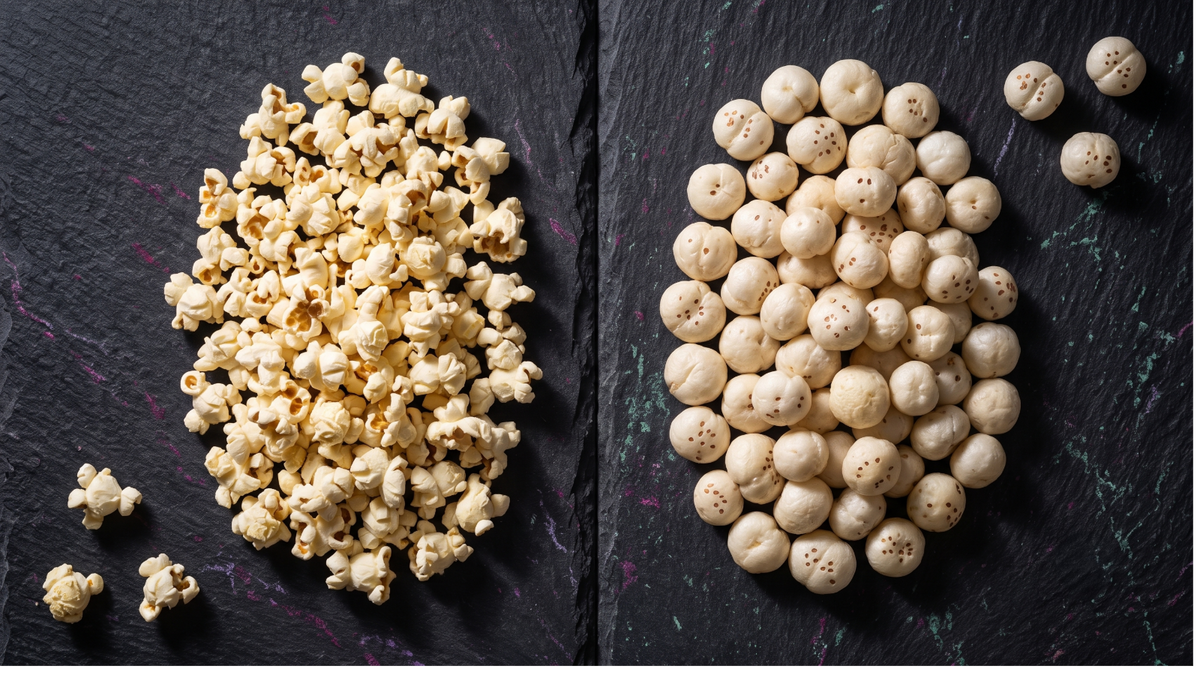
Popcorn has spent a decade as Britain's respectable snack — the thing you reach for instead of crisps. Makhana, the popped water-lily seed, is the newer arrival making a similar claim.
So which is actually better? The honest answer is that it depends what you want from a snack. Here is the comparison without the marketing gloss, including the places popcorn wins.
They are more alike than you would think
Both are seeds or grains that are transformed by heat rather than by dough or extrusion. Both are naturally light, high in volume for their weight, and naturally low in fat before anything is added. Both are naturally gluten-free in their plain form.
The differences appear in three places: what happens during processing, the fibre and fat that end up in the finished product, and the eating experience.
1. Processing: air, oil or fat?
Plain air-popped popcorn is genuinely lean. The problem is that very little popcorn is sold plain — most retail popcorn is popped in oil, or finished with butter, sugar or toffee, and that is what pushes the fat and calorie content up.
Makhana behaves the same way. A roasted, lightly seasoned makhana is a light snack. A deep-fried, heavily coated one is not. The processing matters more than the raw ingredient. Pop Pearls are roasted, never deep-fried, and use no palm oil.
The lesson
Compare products, not categories. An air-popped plain popcorn will beat a deep-fried makhana every time — and vice versa. Always read the pack.
2. Nutrition: where each one leads
Broadly, and depending on the specific product:
- Fibre — both contribute. Wholegrain popcorn is a genuinely good fibre source, and this is a real strength of popcorn that is often overlooked.
- Fat — makhana is naturally very low in fat, and roasted versions stay low. Oil-popped and buttered popcorn does not.
- Protein — makhana generally provides somewhat more plant protein per serving.
- Minerals — makhana supplies magnesium, calcium, potassium and phosphorus.
Exact figures for our three flavours are printed on each product page — see Pink Salt & Black Pepper, Dark Cacao and Peri-Peri & Lime.
3. What the research says about roasting makhana
One genuinely interesting finding is that roasting makhana appears to increase several of its useful compounds rather than degrade them. Research published in Food Production, Processing and Nutrition reported that roasted fox nuts contained higher concentrations of phenolics, flavonoids, minerals and antioxidants than raw seeds, and showed a low glycaemic index in human subjects [1].
A 2023 study measuring raw against popped makhana found total phenolics rose from about 346 to 471 mg GAE/100g and antioxidant activity improved substantially after popping and roasting [2].
We are not aware of equivalent head-to-head clinical trials comparing makhana directly against popcorn in the same subjects — so treat any confident claim of a winner, including ours, with appropriate scepticism.
4. The eating experience
This is where makhana has its clearest, least arguable advantage.
- No hulls. Popcorn leaves kernel fragments that wedge between teeth and under gums. Makhana has no hull — it simply dissolves as you chew.
- No unpopped kernels. No risk of biting down on a hard one.
- Less mess. Roasted makhana leaves far less grease on your fingers than buttered popcorn.
- Sturdier. It survives a bag or lunchbox without turning to crumbs.
5. Where popcorn genuinely wins
In the interests of a fair comparison:
- Price. Popcorn is far cheaper. Makhana is hand-harvested from pond beds, and that labour is reflected in the cost.
- Availability. Popcorn is in every shop in Britain. Makhana is not — yet.
- Wholegrain status. Popcorn is a wholegrain, which carries well-established dietary benefits.
- Familiarity. Nobody needs popcorn explained to them.
The verdict
If you want the cheapest wholegrain snack, buy plain popcorn. If you want something lighter on fat, higher in minerals, easier on your teeth and more interesting to eat — makhana earns its place.
The realistic answer for most people is both. Start with the Trio Bundle to find your flavour, or see the whole range in our shop.
Next: why fibre is the snack nutrient most of us are missing.
References
- Roasted fox nuts (Euryale ferox L.) contain higher concentration of phenolics, flavonoids, minerals and antioxidants, and exhibit lower Glycemic Index (GI) in human subjects. Food Production, Processing and Nutrition. link.springer.com
- Differentiating the nutrient composition, in-vitro starch digestibility, individual polyphenols and anti-oxidant properties of raw and popped makhana. Journal of Food Measurement and Characterization, 2023. link.springer.com
- Fibre. British Dietetic Association. bda.uk.com
Comparative values depend heavily on the specific product and preparation. Always check the label. This article is general information, not dietary advice.
